Skip to main navigation menu Skip to main content Skip to site footer

Volume 7, No. 2Western Nigeria Journal of Medical Sciences

Published December 31, 2024

Original Article

  1. Anthropometric parameters and the pattern of morbidities among elderly patients in the general out-patient clinic, University of Ilorin Teaching Hospital, Ilorin, Kwara State, Nigeria

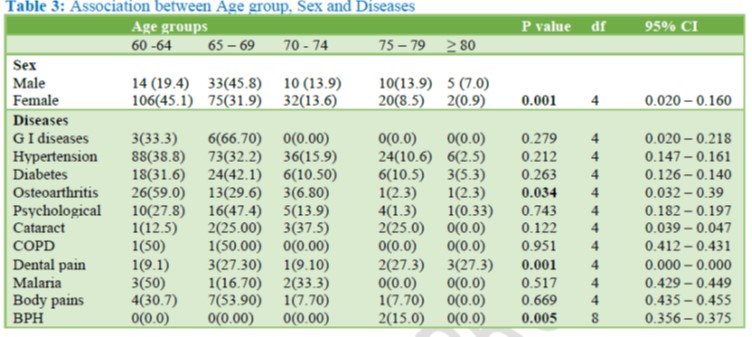
    Introduction: Most elderly people suffer from various chronic medical diseases whose can be evaluated by anthropometric parameters, but these parameters are not sufficiently used by healthcare givers during clinical evaluation.  This study is aimed at determining the anthropometric parameters and the pattern of morbidities among elderly patients in the General Out-Patient Clinic in the University of Ilorin Teaching Hospital (UITH), Ilorin, Kwara State, Nigeria.

    Methods: This was a cross-sectional descriptive study carried out among 307 elderly participants. They were assessed using an interviewer-administered questionnaire and the anthropometric parameters (BMI, MUAC, and Calf Circumference) measured following standard guidelines. The data analysis was done using Version 21 of the Statistical Products and Service Solutions (SPSS-21). Chi-square was used to test associations and p-value < 0.05 was considered statistically significant.

    Results: About a quarter of the elderly (26.7%) were overweight while 12.4% were obese. Close to one third of the respondents (29.3%) had low calf circumference, while 3.9% among the respondents had low MUAC. The most prevalent disease among the respondents was hypertension (53.0%), followed by diabetes (13.3%) and osteoarthritis (10.3%). Majority of the respondents (78.2%) were taking multiple medications while 39.1% of the respondents reported history of multi-morbidity. BMI showed a statistically significant relationship with hypertension, diabetes, osteoarthritis, and psychological problems, age, sex, MUAC and CC.

    Conclusion: Anthropometric measurements are important tools to assess the clinical status of the elderlies during their routine visit for care.
     

  2. Challenges faced by nursing students during practice of nursing procedures in clinical posting in a tertiary institution in Nigeria

    Introduction: This study evaluated the challenges faced by Nursing Students in the implementation of nursing procedures in clinical areas.

    Methods: Descriptive cross-sectional research design was used for the study. Using purposive sampling method, 187 nursing students from two nursing institutions participated in the study. A structured self-administered questionnaire was used for data collection. Data were analyzed using frequencies, and percentages while associations and relationships between variables were tested using chi-square test and regression analyses at p < 0.05% level of significance.

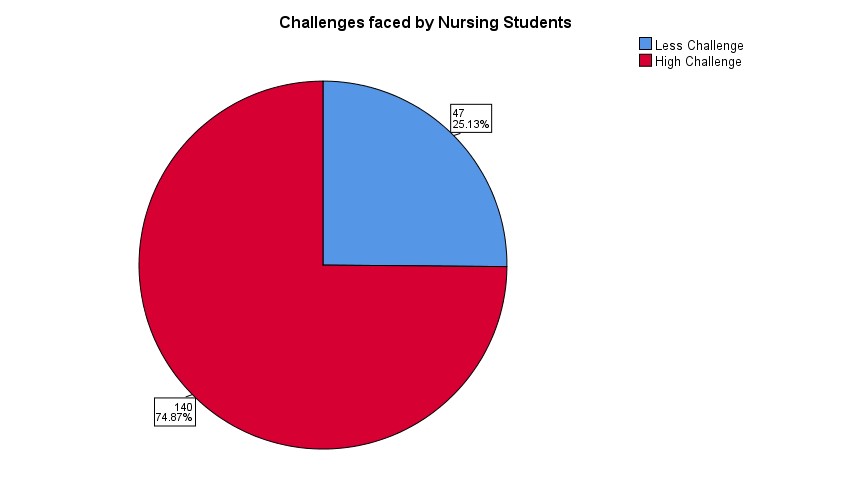
    Results: The mean age of the respondents was 21.5 ± 2.9yrs. About 74.9% of the respondents found clinical postings to be highly challenging. Inadequate physical resources (p= 0.009) and inadequate personal protective equipment to work with during clinical postings (p= 0.003) had a significant influence on the challenges faced by respondents.

    Conclusion: Clinical postings were found to be highly challenging for most respondents as they could not implement certain procedures easily. This could be due to inadequate physical resources and inadequate personal protective equipment to work with. Therefore, it is important to put all available resources in place and get competent and experienced preceptors to guide the students during clinical postings.

  3. Determinants and outcome of dysglycaemia in a children emergency ward, south-west Nigeria

    Introduction: Dysglycaemia is an abnormal blood glucose concentration. It is not uncommon in acutely ill children and could lead to significant preventable complications. This study evaluates its determinants and outcome in a children emergency ward. 

    Method: The study was carried out at the Children Emergency Unit of Teaching Hospital, Osogbo. One hundred and one consecutive ill children, aged one month to 14 years were studied. At admission, blood glucose was determined. Patients were managed and followed up to determine duration of hospital admission and immediate outcomes.

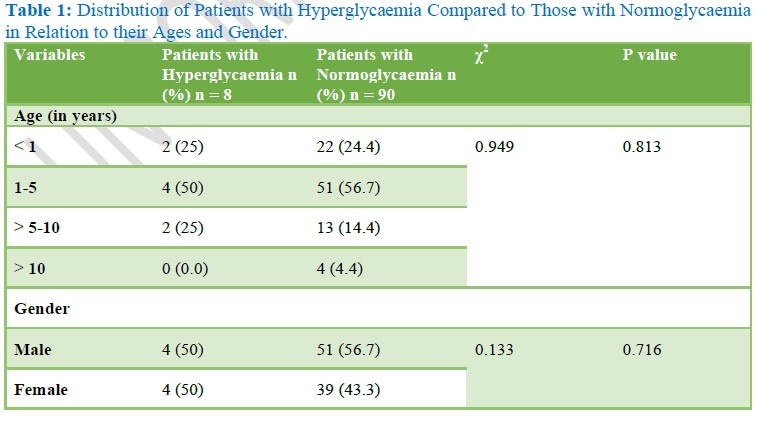
    Result: 56 (55.4%) were males and 45 (44.6%) were females, giving a male: female ratio of 1.24: 1. The mean ages of the patients was 40.83 (3.65) months. The blood glucose of the patients ranged from 1.60 to 10.20mmol/L with a mean of 5.19 (1.42) mmol/L. Eleven (10.9%) of the patients had dysglycaemia comprising 3 (27.3%) with hypoglycaemia and 8 (72.7%) with hyperglycaemia. The remaining 90 (89.1%) patients had normoglycaemia.  Of the 3 patients with hypoglycaemia, severe malaria was the commonest diagnosis, while respiratory infection was the commonest among the 8 patients with hyperglycaemia. The mean duration of admission was longest among patients with hyperglycaemia. Four (4.5%) of the 90 patients with normoglycaemia had varying complications, the outcome is worse in patients with hypoglycaemia compared to those with normoglycaemia (p= 0.012).

    Conclusion: In conclusion, dysglycaemia occurred among acutely ill children with prevalence of 10.9%. Worsening morbidity could be associated with dysglycaemia.  There was apparent poorer outcome in patients with hypoglycaemia.


  4. Prevalence, pattern and treatment outcome of newborn birth injuries among neonatal unit admissions in a teaching hospital in south-western Nigeria

    Introduction: Neonatal birth injuries (NBI) are a diverse set of mechanical traumas from tractions and compressions affecting neonates during delivery, and these range from minor bruises and lacerations to significant injuries such as obstetric fractures and nerve injuries. This study aimed to determine the prevalence, pattern, and outcome of newborn birth injuries seen at UNIOSUN Teaching Hospital (UTH), Osogbo.

    Methods: This retrospective descriptive study was conducted at UTH, Osogbo, in Osun State, South-Western Nigeria. The data of the 190 neonates with birth injuries attended to in the hospital's neonatal unit over 11 years from 1st January 2012 to 31st December 2022 were collected. The data were analyzed using the IBM Statistical Package for Social Sciences version 23 (SPSS 23).

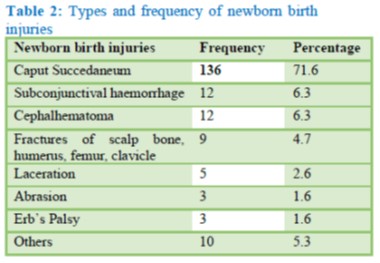
    Results: The prevalence rate of NBI was 100.2/1000 NU admission (10%). The most common type of birth injury was caput succedaneum, accounting for 71.6% of the cases. Perinatal asphyxia was the dominant associated co-morbidities (79.5%). Most (98.9%) had favorable outcomes, while 1.1% were referred on account of residual deformity. The mode of delivery, place, and duration between delivery were significantly associated with treatment outcomes (p-value <0.001, 0.003).

    Conclusion:  The prevalence of neonatal birth injuries was high in our study. Caput succedaneum was the predominant NBI in our survey.

Review Article

  1. Challenges of cadaver dissection for Anatomy teaching and learning during Covid-19 pandemic in a developing country: a review

    The infectious nature of the severe acute respiratory syndrome coronavirus SARS/COV-2 (COVID-19) poses serious challenges to anatomy education in higher institutions with migrations to the virtual environment. Cadaveric dissection involves the use of human remains for learning purposes in anatomy education therefore there is a need for regular supply. The major source of supply for human remains is from unclaimed bodies, body donation and imported cadavers from other countries. To sustain anatomical dissection, actions need to be taken by key stakeholders to ensure the continual use of cadaveric material in the dissemination of anatomical education. This article narrates the challenges encountered as part of effective teaching and learning of anatomy during the COVID-19 pandemic and also explores actions that need to be taken by key stakeholders to ensure a safe and effective cadaveric dissection learning environment in the face of a pandemic.

Case Report

  1. Iatrogenic tension pneumothorax from improvised use of urethral catheter and urine bag chest drainage system in a patient with trauma

    Introduction: Chest tube insertion is an established cause of iatrogenic pneumothorax and can be associated with significant subcutaneous emphysema. Inspection for reposition, replacement or removal of clogged blockage can be a lifesaving act against fatal tension pneumothorax. If chest tube is to be improvised, adherence to evidenced - based principle of chest tube drainage system with attention to underwater seal principle is essential.

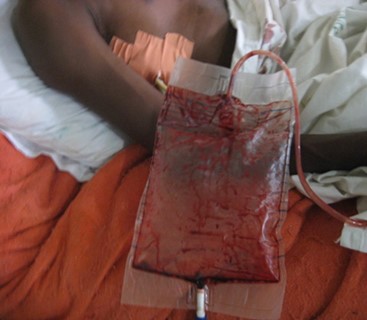
    Case Report: A patient with trauma had improvised Foleys catheter and urine bag as chest drainage system with resultant ballooning of the urine bag with air and development of tension pneumothorax.

    Conclusion: This report highlights the danger of improvising a chest drainage system while ignoring its scientific basis as a cause of tension pneumothorax.

  2. Giant synovial sarcoma of the posterior thigh in an adult African male: a case report

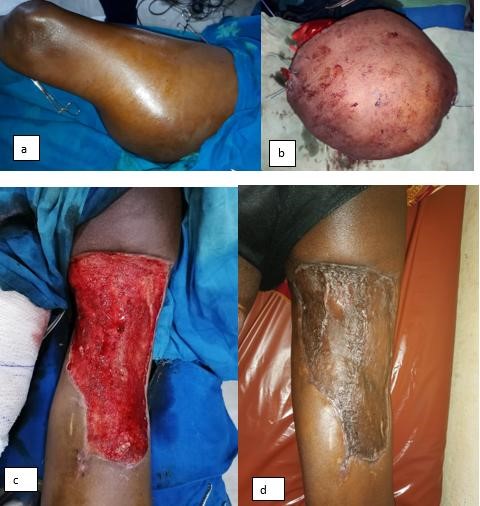
    Case Report: A 65-year-old man presented with 5-month history of a painless progressive posterior right thigh swelling with no impairment of ambulation. Examination revealed a huge mass of the posteromedial thigh measuring 32cm x 24cm x 16cm in the widest dimensions. A provisional diagnosis of soft tissue sarcoma was made and was supported by the magnetic resonance imaging findings of heterogenous consistency of the mass. He had a wide local excision done with a gross tumor free margin and split thickness skin grafting of the residual defect at a second surgery 3 weeks after. The histopathological diagnosis was initially categorized under the broader classification of undifferentiated pleomorphic sarcoma with histologically free tumor margin noted. Immunohistochemical staining further characterized the lesion as poorly differentiated synovial sarcoma. The post-operative recovery was initially smooth with a well-healed defect. However, the patient declined further treatment and died 4 months post-tumor excision from an early aggressive recurrence.

    Conclusion: The occurrence of an aggressive, rarely diagnosed, synovial sarcoma in an adult African man is highlighted. A fatal outcome from an aggressive early recurrence occurred despite histologically clear resection margins.