Volume 6, No. 1Western Nigeria Journal of Medical Sciences

Issue description
Vol. 6 No. 1 (2023): Western Nigeria Journal of Medical Sciences
Published in loving memory of our pioneer Editor-in-Chief, Professor Gabriel Ademola OYEDEJI (1930-2022)
Editorial

Original Article
-
Factors Influencing Usage of Mobile Authentication Services in Identification of Fake Anti-Malarial Drugs among Lagos Residents
Introduction: Malaria medications are in high demand, and they have inappropriately become a target for pharmaceutical counterfeiting. Mobile Authentication Services (MAS) are used to identify fake drugs and confirm the authenticity of products. The objective of this study is to identify factors influencing the use of MAS in the identification of fake antimalarial drugs.
Methods: This was a descriptive cross-sectional study of 350 people. Respondents were chosen using the multistage sampling method and the research instrument was a semi-structured interviewer-administered pre-tested questionnaire. Data was analyzed using SPSS software version 23, with the level of significance set at 5%.
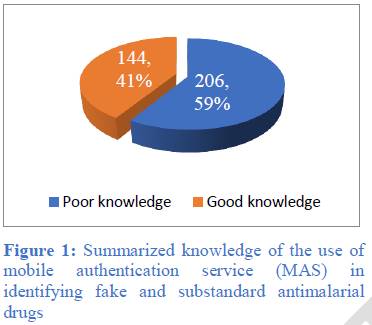
Results: The study found that 38.6% of respondents were of aged 38 years and above, 76% were females, 67.4% were of the Yoruba ethnic group, 72% were married, 35.1% had a tertiary education, and 55.1% were traders. Only 41% and 43.1%, respectively, were aware of the anti-fake and substandard antimalarial drug campaigns and the use of mobile authentication services in identifying fake and substandard antimalarial drugs. Less than half of respondents (41%) had good knowledge of the mode of operation and benefits of the services, and just 20% were currently using the services. Religion, education, occupation, residential area and knowledge were determinants of current utilization (P < 0.05).
Conclusion: Consumers in Lagos State are unaware of the use of MAS to detect counterfeit anti-malarial drugs. Health promotion programs are essential to promote its usage, most especially among those with low levels of education.
-
Prevalence of Malnutrition among Under-Five-Year-Old Pupils of Public Primary Schools: A Case Study of Osun West Senatorial District
Introduction: Malnutrition is a serious threat to the development of young children and the nation and if not tackled on time can lead to the untimely death of the affected children. Adequate data are needed to enable policymakers develop sustainable strategies to stem this problem that has become a global public health issue. The objective of this study is to determine the prevalence of malnutrition among under-five year pupils in public primary schools in the Osun West Senatorial District.
Methods: This is a descriptive school-based cross-sectional study. A semi-structured questionnaire was used to obtain data from respondents. A portable stadiometer was used to measure height, while a bathroom weighing scale was used to measure the weight of the respondents. Stunting, wasting, and BMI were calculated using WHO Anthroplus software and were exported to SPSS 20.0 version for descriptive and inferential analyses. Chi-square was used to analyse categorical data. Statistical Significance was set at p< 0.05.
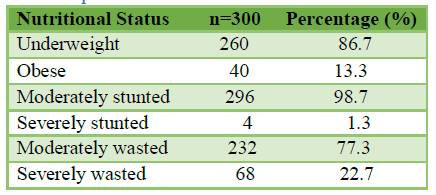
Results: Of 300 participants included in the study, 260(86.7%) were underweight (malnourished) while 40(13.3%) of them were obese. About 296(98.7%) were moderately stunted while very few {4(1.3%)} of them were severely stunted, 232(77.3%) were moderately wasted and 68(22.7%) were severely wasted. Risk factors of malnutrition indices were age, father’s occupation, family type, ethnicity, and dietary intake.
Conclusion: There is a very high rate of malnutrition in Osun West Senatorial District. There is a need to put in place program that will improve the nutrition of students before it affects their academic performance.
-
Prevalence of Plasmodium Falciparum Among Pregnant Women attending Antenatal Clinics in Osogbo, Osun State, Nigeria
Ba
Introduction: Malaria in pregnancy is a major public health problem in tropical and subtropical regions of the world. We aimed to study the prevalence of Plasmodium falciparum among pregnant women attending antenatal clinics in Osogbo, Osun State.
Methods: It was a cross-sectional study with a total of 243 pregnant women involved. Ethical approval was sought and given. Blood samples were obtained for both thick and thin film, stained with Giemsa stain and examined for Plasmodium parasitaemia. Data were analyzed using Statistical Package for Social Sciences (SPSS 17.0 windows version). The statistical significance of variables was estimated using the Chi-square test. Pearson correlation analysis was used to establish a possible correlation of prevalence with parity, age, and trimester. P-value equal to or less than 0.05 was taken as significant.
Results: One hundred and thirty-one (53.9%) of the women had Plasmodium falciparum parasitaemia. Those within the age group 21-25 years had the highest prevalence of infection (68.8%), while the highest rate of infection (65.8%) was observed among primigravid. A majority (71.2%) of the women who had malaria were in their first trimester.
Conclusion: Malaria parasitaemia in pregnancy is still prevalent in our community, and is more so in young primigravid and in early pregnancy.
ckground: Malaria infection during pregnancy is a major public health problem in tropical and subtropical regions throughout the world. We studied the prevalence of Plasmodium falciparum among pregnant women attending antenatal clinic in Osogbo, Osun State.
Methods: A total of 243 pregnant women were sampled for prevalence of malaria after the calculation of sample size. Blood samples smear both thick and thin were stained with Giemsa stain and examined. The data generated on the prevalence of Plasmodium falciparum was analyzed using statistical programme for service solution (SPSS 17.0 windows version). The statistical significance of variables was estimated using Chi-square test. Pearson correlation analysis was used to establish possible correlation of prevalence with parity, age, trimester. P-values of equal to or less than 0.05 was taken as measures of significance.
Results: Of 243 pregnant women examined, 131 were infected with overall prevalence of 51.3%. Age group 21-25 years had the highest prevalence of infection (68.8%) while the low prevalence of (20%) was in 41-45 years. The highest rate of infection (65.8%) was also observed among primigravid while multigravid had low infection rate of (43.0%). The highest prevalence of malaria (71.2%) was also recorded in the first semester among the pregnant women in the study.
Conclusion: Effective case management in both diagnosis and treatment of malaria is therefore advocated in the first trimester of pregnancy.
-
Indication for Spirometry and Pattern of Lung Functions among Patients in a Tertiary Health Institution in Northwest Nigeria: A Three-Year Review
Introduction: This study aimed to assess the indications for spirometry and lung function patterns among patients attending a tertiary health institution in Northwestern Nigeria.
Methods: The study involved a total of 238 patients who had spirometry done between 2018 and 2020 at the Federal Teaching Hospital Katsina. Patient records, including age, gender, height, weight, BMI, indication for spirometry, and spirometry parameters, were extracted from the unit register. All spirometry tests were conducted using a standard field spirometer. Data were analyzed using SPSS version 21.
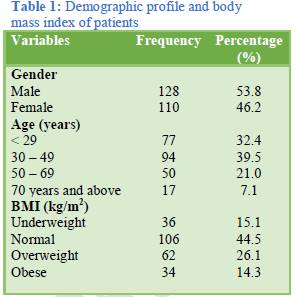
Results: Restrictive pattern of lung function was found in 29.8% of the total patients reviewed while the obstructive pattern accounted for 15.1% and only 4.6% had a mixed pattern of lung function. The commonest indication for spirometry recorded was asthma (37%) while COPD accounted for 17.6% in the reviewed years.
Conclusion: Asthma, medical check-ups, and COPD were the common indications for spirometry, and restrictive lung function was the predominant pattern observed among patients.
-
Pattern of Clinical Presentations at a Sexually Transmitted Infections Clinic in South-West Nigeria
Introduction: Sexually transmitted infections are crucial in public health, they impact sexual and reproductive health in all age groups, especially the reproductive age group. Identifying the common clinical presentations is essential and this was the objective of this study.
Methods: This was a retrospective cross-sectional study. Ethical approval was sought and obtained. Data were obtained from the clinical and relevant laboratory records of 190 patients managed at the Sexually Transmitted Infections Clinic of UNIOSUN Teaching Hospital. The data gathered covered a period spread over 20 years. Analysis was done using the IBM Statistical Product and Service Solutions (IBM®SPSS®Statistics) version 25.0. Association between categorical variables was carried out using the Chi-square and Fisher exact tests.
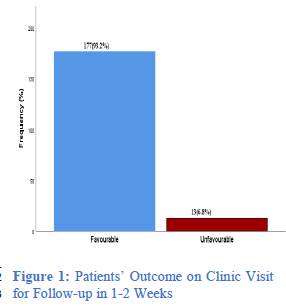
Results: The majority of the patients (n=160, 84.2%) were females and young adults (n=155, 76.3%). The age range was between 14 and 82 years with a mean age of 31.91±9.2 years. The majority of females (n=85, 44.7%) had candidiasis, with or without other infections, while a diagnosis of pelvic inflammatory disease (PID) was made in 39 (20.5%) of the women. Fifteen patients (7.9%) had gonorrhoea while 5 (2.6%) had syphilis. Other common cases seen were non-specific vaginitis (20.5%), perineal warts (7.3%), and herpes infection (3.7%). About 93.2% of the patients had favourable outcomes on follow-up visits.
Conclusion: Women and young adults are likely to present more at the Sexually Transmitted Infections Clinics in our Hospital. The commonest diagnoses are candidiasis, pelvic inflammatory disease and non-specific vaginitis.
-
Assessment of Lipid Profile Parameters among Gravid Women in a Tertiary Health Institution, Southwest Nigeria
Introduction: Plasma lipid concentrations increase markedly during pregnancy due to estrogen stimulation and insulin resistance. This study aimed to assess the lipid profile parameters in apparently normal pregnant women.
Methods: The study was a comparative cross sectional study carried out among ninety-six consecutive pregnant women in all trimesters of pregnancy. Participants were selected by simple random technique during the antenatal clinic days with informed consent. Clinical assessments including weight, height and body mass index (BMI) were determined. 5mls blood specimens was collected for the fasting lipid profile into lithium heparin sample bottles and plasma was separated into a plain bottle and frozen at -20oC until assay time. Data were analyzed using SPSS version 20.
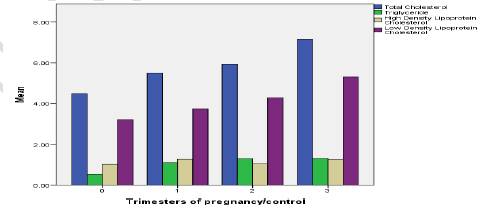
Results: The mean total cholesterol (6.26 ± 1.44 vs. 4.44 ± 1.01 mmol/L, P=0.001), LDL-c (4.54 ± 1.40 vs. 3.21 ± 0.87 mmol/L, p=0.010) and Triglycerides (1.26 ± 0.47 vs. 0.52 ± 0.27 mmol/L, p<0.001) were significantly higher during pregnancy. The total cholesterol and LDL-c were highest in the third trimester while the increase in triglycerides was more in the first trimester with only a modest increase in the second and third trimesters.
Conclusion: All the lipid profile parameters were higher in pregnant women but with different patterns.
-
Evaluation of passive leg raising test for predicting fluid responsiveness in shock patients
Introduction: Intravenous fluid administration remains the primary therapeutic intervention for haemodynamically unstable patients. However, studies have shown that about 50% of such patients would not respond to fluid therapy only. This study evaluates the predictive value of passive leg raising (PLR) test in predicting fluid responsiveness in shock patients.
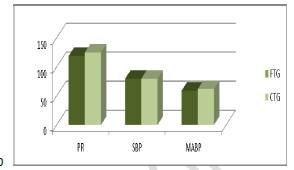
Methods: Adult patients who were in a state of continuous shock (systolic blood pressure < 90mmHg) after initial fluid resuscitation in accident and emergency unit in a teaching hospital in Nigeria over a six-month period were enrolled. All the patients underwent passive leg raising (PLR) test, and were then divided into PLR responders (systolic blood pressure >90mmHg) and PLR non-responders (systolic blood pressure <90mmHg) following PLR. This was followed by further re-categorization into two sub-groups; those who responded to fluid therapy to maintain blood pressure (FTG) and those who required cardiotonic drugs (CTG). The pre-intervention and post-intervention vital signs were then retrospectively analysed between the groups.
Results: Twenty-five patients’ results were analysed for the study. The mean age of the patients was 50.6±4.64 years with male to female ratio of 1.2:1. The mean age of the patients in FTG and CTG were comparable (51.67±3.54 vs49.53±5.28; p= 0.2378). Twelve patients responded to Passive Leg Raising (PLR) test and 13 patients failed to respond to PLR. Nine (75%) out of 12 patients that responded to PLR were successfully managed with fluid therapy as compared to 2 (15.38%) out of 13 non-responders who were successfully managed with fluid therapy only (p=0.0094) giving PLR 75% and 85% positive predictive value and negative predictive value respectively in predicting pre-load dependent circulation.
Conclusion: Passive leg rising can be used as a guide for fluid replacement in patients with shock. Other interventions should be considered early in patients who failed to respond to passive leg raising.
-
Prevalence and Sociodemographic correlates of depression in elderly patients with knee Osteoarthritis attending a Teaching Hospital in SouthWest Nigeria
Introduction: Knee Osteoarthritis (OA) is a common disease of the aged population and one of the leading causes of disability. Depressive symptoms are associated with increases in pain and functional limitations in knee OA. An increased risk of depression has been observed among the elderly that have knee OA due to unrelenting pain, excess suffering, and disability. This study aims to determine the prevalence and sociodemographic correlates of depression in elderly patients with knee OA attending UNIOSUN Teaching Hospital (UTH) Osogbo to help healthcare providers better understand the risk factors for these conditions and develop interventions that are tailored to the needs of this specific population.
Methods: A hospital-based cross-sectional descriptive study of 147 elderlies with knee OA attending Geriatric and Orthopaedic clinics was carried out. A geriatric depression scale (GDS) was used to assess depressive symptoms. The co-interaction of sociodemographic variables and GDS were determined using Chi-square and logistic regression statistics. Statistical significance was set at p-value of <0.05.
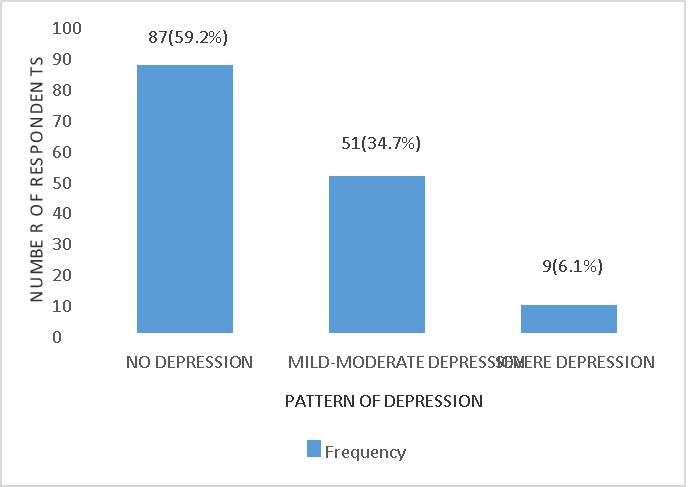
Results: There was a male-female ratio of 1:1.49 in this study. Most respondents were in their seventh decade, female, in a monogamous and nuclear family setting. Most had 3-5 children, and had secondary-level education. The prevalence of depression in the elderly with knee Osteoarthritis was 40.8% with a predominance of mild-moderate depression (34.7%), while severe depression was lower (6.1%). Age 60-64 years, extended family, and having six or more children were predictive of depression.
Conclusion: The prevalence of depression was high among elderlies with knee Osteoarthritis with a predominance of mild to mild-moderate depression.
-
Assessment of Left Ventricular Systolic Dysfunction among Human Immunodeficiency Virus infected Children in Ilorin North-Central Nigeria
Introduction: Human immunodeficiency virus (HIV) is a multi-systemic infection affecting the cardiovascular system with the left ventricle particularly at a higher risk. Most children with this infectious disease acquired it early in their lives through vertical transmission, thus they live to contend with its attendant complications from chronicity. Echocardiography is one of the gold standards for the assessment of cardiac function of these children. This study determined the prevalence of left ventricular systolic dysfunction among HIV-infected children.
Methods: A comparative cross-sectional study among 100 HIV-infected subjects and an equal number of HIV-negative controls aged 2–14 years were recruited consecutively through the Paediatric HIV and out-patient clinics respectively. Recruitments and echocardiography for both groups lasted 4months. Data was analysed with SPSS® v 20. Results were presented in tables as frequencies and percentages. Mean and standard deviation of normally distributed data were determined. Categorical variables were compared using chi-square test. Significant p is < 0.05.
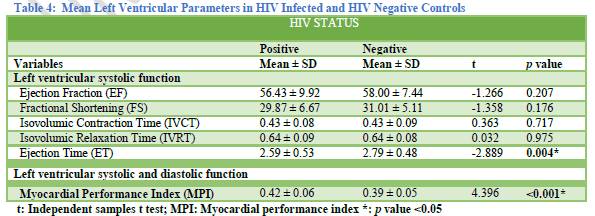
Results: The mean age of participants was 9.42 ± 2.99 years. There were more males with M: F of 1.4:1. Two-thirds were of the lower social class and at the asymptomatic phase while almost all were on HAART. The prevalence of left ventricular systolic dysfunction among subjects was 36% compared with 18% among controls (p = 0.004).
Conclusions: HIV-infected children are twice predisposed to developing left ventricular systolic dysfunction compared with the HIV-negative children. Most of the HIV-infected children in this study were males, at the asymptomatic phase, on HAART and belonged to the lower socio-economic status.
-
Methanolic Fraction of Buchholzia coriacea Seed Extract Up-Regulates Hippocampal BDNF Expression and Ameliorate Cognitive Deficits in Manganese-Induced Parkinson-like Neuropathology
Introduction: Manganese (Mn) is essential for a variety of physiological processes, but at elevated levels, can be neurotoxic. The aim of the current study was to investigate the impact of methanolic fraction of Buchholzia coriacea (MFBC) on cognitive function and determine whether targeting brain derived neurotrophic factor (BDNF) pathway could modify the parkinsonian effects of Mn-toxicity in the hippocampus.
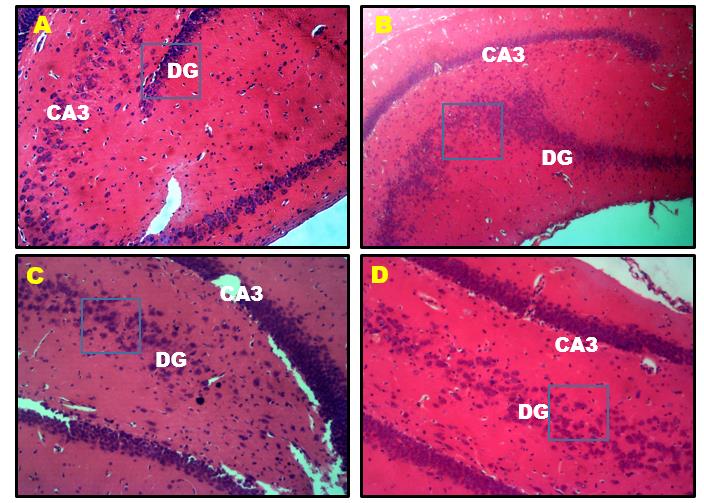
Methods: 28 adult Wistar rats were randomized into four groups (n=7): A=control group; B=Mn only (100 mg/kg); C=MFBC only (100 mg/kg); and D=Mn (100 mg/kg) + MFBC (100 mg/kg). Behavioural assessment, morphological changes in the neurons of the hippocampus, estimation of the activity of oligomeric α-synuclein as well as the impact of Buchholzia coriacea on BDNF expression in the hippocampus were examined. Cortical sections were stained for histological investigations. RT-PCR was used for evaluating BDNF gene expression, and ELISA was used for quantifying dopamine and oligomeric α-synuclein levels. Data was analyzed using one-way ANOVA and Turkey’s post hoc test. p<0.05 was considered significant.
Results: Findings indicated that Buchholzia coriacea (BC) significantly reduced the activity of oligomeric α-synuclein and augmented hippocampal dopamine activity. Mn-toxicity was associated with neuronal damage and depletion in BDNF gene expression, while Buchholzia coriacea up-regulated hippocampal BDNF activity and ameliorated observed structural perturbations.
Conclusion: Methanolic fraction of Buchholzia coriacea seed extract regimen improved the rats' performance cognitive tasks and halted parkisonian changes in the hippocampus.
Case Report
-
Extragonadal mixed germ cell tumour of the face: Report of a rare case and review of literature
Introduction: Germ cell tumours are a heterogenous group of tumours that could be either benign or malignant, and they primarily present as gonadal tumours. Extragonadal germ cell tumours (EGCT) are rare and represent 1-5% of all germ cell tumours and they arise in anatomical locations other than the gonads. Extragonadal germ cell tumours broadly include seminomatous and non-seminomatous tumours, with different morphologies which include mature cystic teratoma, immature teratoma, seminoma, yolk sac tumour, embryonal carcinoma, choriocarcinoma and mixed germ cell tumour. Extragonadal germ cell tumours mostly affect children and young adults, usually involve the structures along the midline of the body and are more common in males. Head and neck region is an uncommon primary site for EGCT with most tumours being benign and teratoma being the main histologic type. The exact aetiology is unknown and it has a poor prognosis compared with its gonadal counterparts.
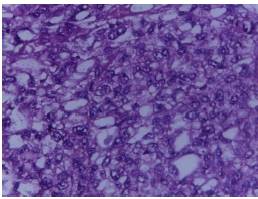
Case: We report a case of a 3-year old girl who presented to a peripheral private facility with a right facial swelling. She had incisional biopsy done which was uneventful. The tissue was processed in our histopathology laboratory and a diagnosis of extragonadal mixed germ cell tumour was made.
Conclusion: Extragonadal mixed germ cell tumours of the head and neck are rare and accurate histological diagnosis is essential for correct management of the patient.